


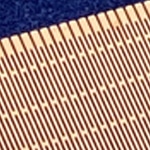
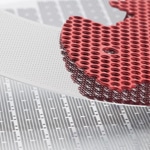
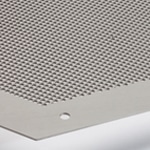
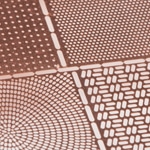
VACCO etches fine mesh and screens with through features as small as 100 microns. These screens are etched from solid sheets of material offering superior mechanical strength, excellent electrical conductivity, and reliable integrity of pore size regardless of flow characteristics. VACCO’s fine screens can be made of titanium, nitinol, stainless steel, nickel, copper, or any other material etched at VACCO, see Design Guide.
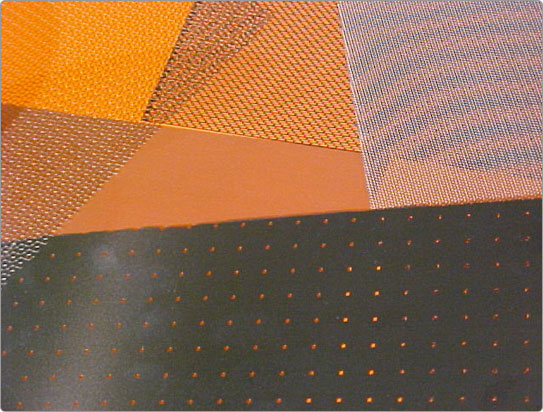
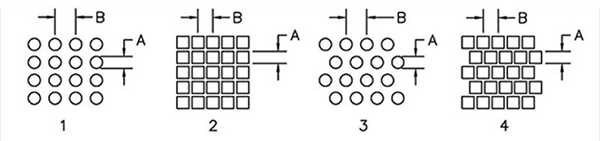
Patterns are wide-ranging, from: round, elongated, hexagonal, square, octagonal, rectangular, and so on. All inside corner radii will be equal to material thickness, and the hole must be equal to or larger than the material thickness. With VACCO you have the flexibility to achieve some transmission and open area issues you cannot achieve through other methods of manufacturing.
Through hole features are normally etched equally (50/50) from both sides of the process sheet. VACCO can etch at different proportions (i.e. 80/20 or 60/40) which can produce conical-shaped through hole features, helping to achieve unique flow characteristics benefiting certain applications. Review the diagram below showing the difference of a 50/50 etch profile compared to an 80/20 etch profile.
APPLICATION EXAMPLES OF FINE MESH & SCREENS:
- Medical reconstructive surgery mesh
- Filtration (minimum 75 microns)
- Extrusion screen for fiber and plastic
- Protective barrier filter for contamination
- Faraday shielding for medical sensors
- Air flow control for paper transport
- Sorting & Sieving
- EMI/RFI Shielding
- Carrier and Supports
- Many others
Problems Addressed with VACCO Screens & Meshes
Many applications require screens and meshes with precise pore sizes, consistent flow characteristics, and reliable mechanical strength. Traditional manufacturing methods often fall short. Common challenges include:
- Difficulty achieving uniform openings at micron level dimensions.
- Inconsistent pore geometry that affects filtration or flow performance.
- Mechanical weakness in woven or mechanically punched screens.
- Limited pattern options when using conventional tooling.
- Variability in open area ratios that impact system efficiency.
Etched screens and meshes help overcome these issues by providing repeatable, accurately defined features across a wide range of materials.
Design Considerations
Fine screens and meshes benefit from early design collaboration to ensure optimal performance. Key considerations include:
- Minimum feature size and material thickness relationships.
- Required open area percentage for filtration, shielding, or flow control.
- Pattern geometry (round, hexagonal, elongated, square, etc.) based on application needs.
- Whether a 50/50, 80/20, or 60/40 etch profile is best for desired flow characteristics.
- Mechanical strength requirements for handling, assembly, or long term use.
These factors help determine the ideal pattern, material, and etch profile for each project.
Fine Mesh Frequently Asked Questions
What Fine Mesh Feature Sizes Can Be Achieved?
Through features as small as 100 microns can be produced with consistent accuracy across the entire fine mesh.
Which Materials Can Be Used for Etched Screens?
Screens can be made from titanium, nitinol, stainless steel, nickel, copper, and other materials supported by the etching process.
What Pattern Shapes Are Available?
Patterns include round, elongated, hexagonal, square, octagonal, rectangular, and many other geometries depending on application requirements.
Can Etch Profiles Be Customized?
Yes. Screens can be etched at 50/50, 80/20, or 60/40 proportions to create straight wall or conical shaped openings that influence flow behavior.
